
The Tāla Framework — 6 Steps
A consistent sequence teachers follow when planning every lesson.
The Learning Journey
Four levels, each with its own musical identity.


IB & CIE Alignment
Sing Move Play is built around concept-based, transdisciplinary learning — the same principles that underpin the IB Primary Years Programme and Early Years framework, and CIE's Cambridge Primary curriculum. Every lesson centres on one musical concept explored in depth, connects naturally across subject areas, and treats the child as an active agent in their own learning rather than a passive recipient. Assessment happens for learning, embedded in the activity itself, not as a separate test at the end.
Step 1 — Core Concept
The 8 Big Musical Ideas. One concept per lesson. Not two. Explored deeply.
Step 2 — Plan with the End in Mind
Before designing the lesson: what will children DO at the end they couldn't do at the start?
Step 3 — Choose a Pathway
Six entry points into the same concept. Choose ONE per lesson.
Step 4 — Teaching Process
The Orff Inquiry Cycle. Not every lesson reaches Stage 4 — imitation is the foundation, not a lesser stage.
Step 5 — Student Agency
Voice, choice, and ownership designed into the lesson. Never added at the end.
- Give choices
- Invite children to lead
- Never correct too early
- Honour every contribution
Step 6 — Assess
Three indicators, observed during the lesson itself — not after it.
Curriculum Alignment
| 01 Core Concept | Concept-Based Learning One big musical idea per lesson. Depth over breadth. Students build genuine understanding, not surface familiarity. |
| 02 End in Mind | Structured Inquiry Every lesson has a clear intended outcome. Start, Middle, End — 80% planned, 20% responsive to the room. Inquiry is purposeful, not accidental. |
| 03 Pathway | Differentiated Learning Multiple entry points per concept. Voice, Rhythm, Movement, Instruments, Art & Story, Games — every child accesses the learning in their way. |
| 04 Teaching Process | Inquiry Cycle Imitation → Exploration → Composition → Improvisation mirrors IB's inquiry cycle. Students move from copying to creating, building understanding through doing. |
| 05 Student Agency | Learner Profile Voice, choice, and a safe space for expression. When children feel safe enough to try, they become Risk-takers, Communicators, and Open-Minded learners. |
| 06 Assess | Formative Assessment Observe, Echo, Reflect. Assessment is embedded in learning — not a test added at the end. Growth is documented, not measured in isolation. |
ATL Skills — Embedded in Every Session
Communication
Singing, call-and-response, group expression, name songs, vocal improvisation
Social Skills
Ensemble work, circle time, peer listening, partner games, turn-taking
Self-Management
Tempo control, start and stop, emotional regulation, instrument care
Thinking Skills
Contrast, pattern recognition, musical form, composition, creative response
Music pathways including story, movement, visual response, and instruments connect to Units of Inquiry without artificial links. Music becomes a vehicle for transdisciplinary learning — not a subject running alongside it.
| 01 Core Concept | Musical Elements Each lesson anchors in one musical element — pitch, rhythm, form, timbre, dynamics, duration, or texture — mirroring CIE's elemental approach to music understanding. |
| 02 End in Mind | Learning Outcomes CIE Cambridge Primary Music defines clear outcomes per strand. Tāla's lesson planning methodology maps directly — students demonstrate understanding through doing, not recall. |
| 03 Pathway | Performing · Composing · Appraising CIE's three strands are embedded in Tāla's six pathways. Every Rhythm, Voice, and Instruments lesson includes performing. Art & Story supports listening and appraising. |
| 04 Teaching Process | Performing Arts Imitation → Improvisation mirrors CIE's progression from guided performance to independent musical expression. Ensemble work and vocal performance build from Cockatoos upward. |
| 05 Student Agency | Composing Strand Free sound-making at Budgies through to structured composition and graphic notation at African Greys — the full CIE composing progression built across four years. |
| 06 Assess | Appraising Strand Structured listening embedded throughout. Children describe, analyse, and respond to musical works — building the critical listening skills central to CIE's appraising strand. |
| Sub-strand | Budgies 2–3 yrs | Macaws 3–4 yrs | Cockatoos 4–5 yrs | African Greys 6–7 yrs |
|---|---|---|---|---|
| Beat | Steady beat | Steady beat | Beat vs no beat · Steady beat · Strong beat / weak beat | Beat vs no beat · Steady beat · Beat vs rhythm · Strong beat / weak beat |
| Tempo | Fast and slow | Fast and slow | Fast, medium, slow | Fast, medium, slow |
| Dynamics | Loud and soft | Loud and soft | Loud and soft | Loud and soft |
| Duration | Long and short | Long and short | Long and short | Long and short |
| Meter | Simple patterns | Simple patterns | Patterns of 2, 3 and 4 · Meters of 2 and 4 | Meters of 2, 3 and 4 · Patterns of 2, 3 and 4 |
| Combinations | Same or different | Same or different | Same or different · Ostinato: combinations including quarter note, two eighth notes, quarter rest · Improvise patterns | Same or different · Ostinato: combinations including quarter note, two eighth notes, quarter rest · Improvise patterns |
| Sub-strand | Budgies 2–3 yrs | Macaws 3–4 yrs | Cockatoos 4–5 yrs | African Greys 6–7 yrs |
|---|---|---|---|---|
| Pitch | High and low with melodic direction | High and low with melodic direction | High and low with melodic direction · Upward and downward | High and low with melodic direction · Upward and downward and pitch matching |
| Patterns with solfège | — | New pitches: Sol, Mi | New pitches: Sol, Mi, La · Combinations: Sol-Mi, Sol-Mi-La, Sol-La-Sol-Mi | Phrases · New pitches: Do, Re · Combinations: Sol-Mi, Sol-Mi-La, Sol-La-Sol-Mi, Do-Mi-Sol-La, Sol-Mi-Do, Do-Re-Mi, Mi-Re-Do |
| Sub-strand | Budgies 2–3 yrs | Macaws 3–4 yrs | Cockatoos 4–5 yrs | African Greys 6–7 yrs |
|---|---|---|---|---|
| Form | Call and response | AA form · Call and response | AA form · Call and response · AB (binary) form · Verse/chorus | AA form · Call and response · AB (binary) form · Verse/chorus · Determining form · ABA (ternary) form · Repeat |
| Sub-strand | Budgies 2–3 yrs | Macaws 3–4 yrs | Cockatoos 4–5 yrs | African Greys 6–7 yrs |
|---|---|---|---|---|
| Voice / vocal | Whisper, talk, shout, sing · Breathing technique · Vocal warm-up | Whisper, talk, shout, sing · Breathing technique · Vocal warm-up | Whisper, talk, shout, sing · Vocal chords · Chest/head voice · Breathing technique · Vocal warm-up | Whisper, talk, shout, sing · Vocal chords · Chest/head voice · Breathing technique · Vocal warm-up |
| Song types | Echo singing · Chants | Echo singing · Chants · Call and response | Solo · Chant · Call and response · Echo singing | Solo · Chant · Call and response · Echo singing |
| Sub-strand | Budgies 2–3 yrs | Macaws 3–4 yrs | Cockatoos 4–5 yrs | African Greys 6–7 yrs |
|---|---|---|---|---|
| Unpitched percussion | Woods, shakers, drums, tambourines, claves | Woods, shakers, drums, tambourines, claves | Woods, shakers, drums, tambourines, claves, clatterpillars, guiros | Woods, shakers, drums, tambourines, claves, clatterpillars, guiros |
| Pentatonic bells | Free exploration · Matching one bell to another · Colour-pattern play | Tapping and copying patterns · Playing the scale up and down (C to A) | Play and echo (call and response) · Composing a simple original song | Guessing the missing note · Playing preset pieces and Tāla originals · Composing original melodies |
| Pitched percussion | — | — | Xylophones and desk bells | Xylophones and desk bells |
| Sub-strand | Budgies 2–3 yrs | Macaws 3–4 yrs | Cockatoos 4–5 yrs | African Greys 6–7 yrs |
|---|---|---|---|---|
| Symbols | — | — | Pictorial representations of icons | Pictorial representation of icon notations · Icon notations |
| Sub-strand | Budgies 2–3 yrs | Macaws 3–4 yrs | Cockatoos 4–5 yrs | African Greys 6–7 yrs |
|---|---|---|---|---|
| Performance | Sing and play together in a group in front of an audience | Sing and play together in a group in front of an audience | Play in an ensemble | Play in an ensemble |
| Sub-strand | Budgies 2–3 yrs | Macaws 3–4 yrs | Cockatoos 4–5 yrs | African Greys 6–7 yrs |
|---|---|---|---|---|
| Basic co-ordination | Move arms and legs to the rhythm of simple songs | Move arms and legs to the rhythm of simple songs · Direction: forward, backward, sideways · Explore basic rhythms through clapping, tapping, and moving | Explore basic rhythms through clapping, tapping, and moving · Combine movements to perform simple dance sequences | Combine movements to perform simple dance sequences |
| Body awareness | Identify body parts through movement | Identify body parts through movement · Move in designated spaces without bumping into others | Move in designated spaces without bumping into others · Locomotor: walk, run, jog, hop, tip-toe, jump, gallop, skip · Nonlocomotor: turn, bend, stretch, twist, rise, melt · Formations: circles, lines, free space | Vary movement speed and intensity in response to music · Locomotor: walk, run, jog, hop, tip-toe, jump, gallop, skip · Nonlocomotor: turn, bend, stretch, twist, rise, melt · Formations: circles, lines, free space |
| Creative expression | Imitate simple movements of the teacher or peers | Imitate simple movements of the teacher or peers | Use movement to express feelings about different types of music · Work together to create a short movement routine | Use movement to express feelings about different types of music · Work together to create a short movement routine |
Short sessions (15–20 min). Body movement primary. Simple call-and-response. Contrasts: loud/quiet, fast/slow, high/low. Everything is play. Everything is story.
Sessions 20–30 min. Melodic awareness begins (sol-mi). Beat vs rhythm distinction. Circle games. Folk songs as vehicle.
Sessions 25–35 min. ABA form. Graphic notation begins. Orff instruments introduced. Children begin to lead. Improvisation in structured games.
Sessions 35–45 min. Formal notation introduced. Full Orff ensemble. Composition projects. Performance for audience.
More lessons in the full library

By the end of this warm-up, children will:
- Recognise "Time for music" as the anchor refrain that opens and closes every Tāla session.
- Warm up voice, body, and listening before the main lesson begins.
- Explore a growing vocabulary of body percussion through repetition and variation.
- No instruments required. The song has just two chords, or use the recording.
- Open space for children to move freely.
Every age group, from babies and toddlers to older children. This is a warm-up, not a full lesson — though it can stand alone if needed.
"What time is it?" — the children answer — "It's time for music!" Then everyone sings:
"Time for music, time for music, time for music, everyone."
This can be sung as an A-B or an A-A-B format, so children learn "Time for music" as the refrain they return to again and again.
Show a way of clapping and have the children copy you. Replace "music" with "clapping": "Time for clapping, time for clapping, time for clapping, everyone." Do it once or twice, then come back to "Time for music."
From there, move to a new body percussion each time you return to the refrain: Time for stomping, time for tapping, time for snapping, time for jumping, time for turning — cycling in whatever locomotor or non-locomotor movement fits the moment, then always resolving back to "Time for music."
- Keep each variation to one or two rounds before returning to the refrain — it's the coming back that makes it a warm-up, not a new song.
- Adapt freely to whatever movement or sound you want the children to explore that day.
- This is Tāla's proprietary song, copyrighted to Tāla Education. Teachers are encouraged to adapt it in class, not to reproduce or distribute it outside class.
- All you need to do is watch the video and duplicate it in your own class.
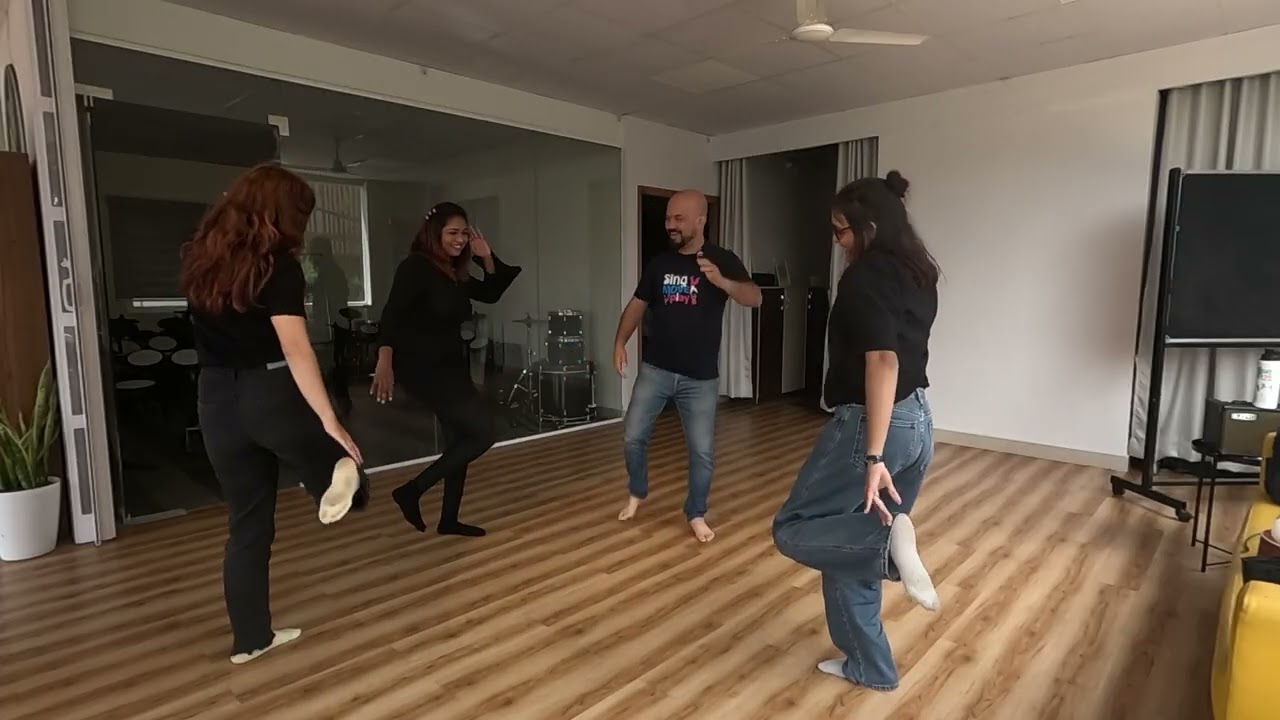
By the end of this class the students will be able to:
- Experience and identify the two-part musical form (A and B) through repeated cycles.
- Respond to music with locomotor and non-locomotor movement.
- Explore body percussion patterns matched to form.
- Develop listening, copying, and following skills through teacher-led and student-led actions.
- Build confidence in movement, rhythm, and creative expression.
- For older groups: collaborate using partner patterns and simple rhythmic play.
- Bluetooth speaker.
- Teacher's voice for humming or singing motifs.
- Scarves (one per child, optional but recommended).
- Rhythm sticks / claves, or a tambourine (introduced in later sections).
- Plain paper and two crayons per child (for the art section).
- Open classroom space, with a circle or semicircle seating arrangement (children start seated).
Early Years to Grade 3. Older children can attempt the extended body-percussion and partnered sections.
Open classroom. Circle or semicircle seating, children start seated.
A and B. The song cycles A B | A B | A B | A B (4 repeats).
One song, five ways to feel the same A and B form: in the body, in the voice, in clapping, on instruments, and on paper. Every stage keeps the same leader-and-follower shape.
- Before children enter, tell them: "Today, we are all bunny rabbits, hopping, jumping, and dancing!"
- Play the Rabbit Polka softly as they enter.
- Children hop into the class like bunnies and gather into a semicircle.
- Stop the music.
- Hum or mouth the melody using simple syllables: "Pum pum para-rum pum pum..."
- Give slow, clear instructions: "Show me bunny ears." "Show me bunny tail." "How do rabbits hop?" "How do rabbits turn?"
- Move through the entire A and B sequence without audio, simply by humming.
Play the Rabbit Polka again and lead the whole gesture sequence in time. Let the children ride the A and B changes with confidence, calling the short prompts ("Ears! Turn! Tail! Hop!") as they go.
- With the recording off, mouth the melody, or play the ukulele using simple syllables like "la la la" or "pom pom pom."
- Model three or four new hand movements, different from the bunny gestures, to show the children they are free to create their own.
- Encourage the class to copy you, then ask: "Who would like to be the leader?"
- Invite children to come up with their own movement patterns, and let the class follow the chosen leader.
- Give them the space to move autonomously, using their own agency, within the same A and B shape.
We're gonna hop like a bunny, hop hop hop,
We're gonna hop like a bunny, hop hop hop,
Hop hop hop and STOP!
We're gonna chew like a bunny, chew chew chew...
(Chomp chomp chomp) ... and STOP!
- Once the movement is established, gesture different ways of clapping. Show at least two or three ways and ask the children: "How do you clap?"
- When a child claps a particular way, use the same song, and this time gesture the clapping action, getting everybody to follow.
- Nominate a leader and let the class follow that leader, giving each child a turn to lead.
- A is the leader's own way of clapping. B is the common pattern everyone already knows and follows.
- As with movement, this can be repeated without the recording, using just your voice and the ukulele, at your discretion.
Because the sequence and the A and B form are now familiar, the step onto instruments is a small and natural one.
- Give each child a simple clave (a tambourine works just as well).
- Just like the clapping, show two or three different ways to play the clave. Let the instrument travel around the circle so everyone tries.
- Seated in a circle, mouth the melody, hold the clave, and lead the A and B synchronisation.
- A is the leader's unique way of playing. B is a common pattern that everyone follows, already established.
- Rotate the leader so every child gets a turn in the A part.
- Give each child a plain sheet divided into two halves, and two crayons. Name the colours as characters: the Red Bunny and the Blue Bunny.
- As the music changes between the A and B sections, the children change colours, colouring with the Red Bunny during A and the Blue Bunny during B.
- On the two halves of the page, each bunny moves differently: the Red Bunny moves one way and the Blue Bunny another, inspired by the movements the children set in the movement activity.
- By the end, the page holds the same A and B story they danced, now in two colours and two characters.
- Keep actions extremely clear and repetitive.
- Use short prompts: "Ears! Turn! Tail! Hop!"
- You do not need to play an instrument, voice and gesture are enough.
- Keep the tone light and playful, and demonstrate gentle hopping for safety.
- Every section keeps the same A and B, leader-and-follower shape, so each new stage feels familiar.
- Repeat each section off the recording, with your voice or ukulele, so children follow you and not just the sound.
- Give every child a turn to lead.
- For older groups, add partner patterns and simple rhythmic play.

By the end of this lesson (spread across 2–3 classes), children will:
- Experience and understand the contrast between slow and fast through story, movement, voice, and play.
- Respond physically and musically to changes in tempo using whole-body movement, gestures, and instruments.
- Participate in call-and-response singing using contrasting tempos for Ramu (slow) and Raju (fast).
- Develop listening, imitation, and switching skills by responding appropriately to slow and fast cues.
- Build early motor coordination, focus, and self-regulation through guided movement and rhythm activities.
- Explore pathways to movement, rhythm, tempo, story, and instrument play in a structured yet playful manner.
- Drum — essential (teacher uses for tempo leadership: slow vs fast).
- Open floor space for movement, crawling, and circle activities.
- Optional percussion (one type at a time): tambourines, egg shakers, rhythm sticks.
- Clear visual boundaries for "House" and "Garden."
- Children seated on the floor initially, with flexibility to move into a standing circle or free movement in space.
Ages 2 to 3 years. Easily adaptable for mixed-age groups.
"Once there were two friends: Raju and Ramu. They hadn't seen each other for a very long time, and they really wanted to meet again. So they decided to have a little party."
Ramu was a snail. He did everything slowly.
"Whenever Ramu spoke, he spoke slowly. Whenever Ramu laughed, he laughed slowly. Whenever Ramu ate, he ate slowly. Whenever Ramu walked, he walked slowly."
To show Ramu, put your fist close to your hand, make a thumbs-up, and move your wrist and thumb like a slow snail climbing up a wooden rail. While doing the action, narrate and recite the lyrics of the song line by line and slowly:
"Slowly slowly very slowly moves the little snail, slowly slowly very slowly up the wooden rail."
You can also say: "Slowly slowly very slowly moves Ramu the snail…"
Make your movements exaggerated, your voice soft and slow, so children clearly associate Ramu with slow movement.
Now introduce Raju. Raju was super fast.
"Whenever Raju spoke, he spoke very fast. Whenever he laughed, he laughed very fast. Whenever he ate, he ate very fast. Whenever he walked, he walked very fast. Everything Raju did was fast, fast, fast."
To show Raju, hold up two fingers (index + middle finger) and make them run very fast like a tiny mouse. You can run your fingers over your arm, pretend they tickle you, or make them zoom across the floor. Children can copy by showing their own two-finger mouse.
Then you say the line: "Quickly, quickly, very quickly moves the garden mouse, quickly, quickly, very quickly to his little house."
Show the "house" by making a small cave shape with your left hand and letting the mouse run into it.
You can also add: "I wonder why Raju is always so fast? Maybe he is scared of a big eagle or snake that might catch him!" — a small line to explain why he hurries to get ready for the party with Ramu.
This establishes the two characters clearly — Ramu = slow snail, Raju = fast mouse.
After telling the story, ask children to copy how Ramu moves. Show the snail action slowly and exaggerate the pace so children clearly understand the "slow" concept. Then shift quickly into Raju's fast movement, using your fingers like a mouse. Encourage children to switch with you: "Show me Ramu… now show me Raju!" Take time here. This is where children understand tempo through their bodies before any music is involved.
Teach the song in small chunks. Children at this age learn best when the line is short and the teacher models first. Start with Ramu's line. Say it slowly with the snail hand gesture. Ask: "My turn…" (you sing) "Your turn…" (they repeat). Repeat until you see their mouths forming the words confidently. Do the same for Raju's line, but use a faster voice and finger action. Combine both lines once they are comfortable. Encourage them to use gestures while singing — this helps internalise the tempo difference.
Have everyone stand in a circle holding hands. Explain that we are now becoming Ramu and Raju with our whole bodies, not just hands. For Ramu's verse, demonstrate taking very small, slow steps while keeping the body relaxed. Sing Ramu's line while walking. Then switch to Raju — children take quicker steps, move lighter on their feet, and show excitement in their faces. The teacher must set the pace clearly, so children don't go too fast and collide. Do 3–4 rounds so the group rhythm becomes synchronised.
Ask children to spread out in the room and give them space. Explain that now everyone can become Ramu the snail and crawl slowly across the floor. Play a slow drum beat and encourage controlled movement — "No bumping into friends, keep your eyes open." This helps children understand tempo through large motor movement, which is essential for ages 3–5. If children enjoy it, repeat in short bursts to keep focus.
Designate two areas of the room: House (a safe place) and Garden (where they collect imaginary items). Explain clearly: "When the drum is slow, you are in the garden like Ramu. When the drum is fast, run like Raju back to the house." Let children "collect" imaginary food or decorations for the party. When you switch to fast drum + sing Raju's line, children must hurry back. Repeat a few rounds to build understanding of spatial awareness and switching tempo.
Hold the drum where all children can see it. Explain that the drum is the leader — it tells us how to move. Play a slow pattern; children move slowly around the space. Then play a fast pattern; children switch immediately to fast movement. This builds listening skills and response time. If a child struggles to switch, slow down the transitions and guide them verbally.
Hand out tambourines, egg shakers, rhythm sticks, or any available percussion (one choice of instrument, preferably at a time). Teach them: "Ramu plays slowly…" (soft taps or slow shakes). "Raju plays fast…" (quick shakes or taps). Do group play first — all children together. Then try turn-taking: "Let's see how you play like Ramu." Rotate instruments so children experience different sound qualities. This builds control, listening, and expressive contrast.
Place the drum in the centre or on a chair, and demonstrate how to play it, saying that you are the leader. Invite one child to be the "tempo leader." The child plays slow or fast; the rest respond by moving or playing instruments. This promotes confidence, agency, and classroom respect. Guide leaders gently if they get stuck or overexcited.
- Do not do all activities in one class. Spread across 3–4 lessons, depending on age.
- Younger children (3–4) need more repetition; older ones move faster.
- "Less is more" — once a child understands one pathway, layer the next one.
- If the teacher feels bored hearing the same tune: children don't. Repetition feels safe, simple, and joyful for them.
- This is an excellent demo lesson for parents or school leadership because it clearly shows structured, playful, concept-based teaching.

By the end of this activity, children will:
- Remember and reproduce a sequence of actions in order.
- Watch a leader closely and follow in time.
- Combine a held body action with a turning, circling movement.
- Enjoy big, funny movements that bend, stretch and stand.
- The Seven Jumps recording, or your own voice / ukulele.
- Open floor space for a circle.
- No instruments needed — the body is the instrument.
Early Years. Scale the number of actions to the group — teacher's discretion.
Seven Jumps. A part: turn in a circle. Each accent: add one held action.
Two rounds, no more. It becomes repetitive quickly. Use it as an opener, then move on.
"I went far away to a land, and I met a king and a queen. They said, 'We are the Horamavu people, show us our dance!' And this is the dance I showed them."
Gather the children and tell them a little story to frame the game. Then you show the dance, and everybody follows you. You are the leader. Swap in a local place name the children know (Horamavu, Kothunur, or your own) so the land feels close to home.
On the running "pa pa pa" section, everyone simply turns and revolves in a circle. Clap, clap, clap, and circle, turning all the way around.
On each long accent (the "daaa"), you add one held body action and keep holding it while you turn. Build the sequence one action at a time, in order. Hold your head and turn. Next time, hold your head, then your cheeks, and turn. And so on.
Head
Cheeks
Shoulders
Tummy
Bummy
Knees
Feet
Between actions, get the children to prompt the sequence back to you. It is a memory game, so keep asking: "What was the first step? Guide me, guide me! And who remembers what came next?"
You stay the leader; they watch you closely and call out the order. Do the whole dance a maximum of two times, then move on before it gets repetitive.
- Keep it to two rounds maximum — it becomes repetitive quickly.
- Build the sequence gradually. A first group may only manage two or three actions, not all seven. Add more as they are ready.
- Choose funny, whole-body actions to keep it active and humorous.
- Let the children guide the order back to you — keep prompting recall.
- Swap the far-away land for a local place name the children know.
- Use this as a strong opener, then move to a more layered song (such as Allelu).
By the end of this lesson, children will:
- Understand musical form: A (the leader's part) and B (the common part we all share).
- Take turns leading and following.
- Find many ways to make one sound, from clapping to claves.
- Feel changes in speed and dynamics: fast and slow, loud and soft.
- The Allelu recording, and ideally a ukulele.
- Claves, one pair per child (or mallets if you have fewer).
- Open floor space for a big circle.
Early Years to Lower Primary. A full lesson on its own for older children; simplify the layers for younger ones.
Greet every child at the door and bring them in with a rhythm or a song already playing. Then settle into the "Time for Music" chant, roughly five minutes, kept fresh with variation.
"Time for music, time for music, everyone. Time for clapping, time for clapping, time for clapping, everyone."
Keep it short. If more concepts are coming later in the lesson, trim the warm-up so the children stay fresh.
Show four different ways to clap, and have the children copy each one. This sets up the whole lesson: I clap a way, you clap that way. I am the leader, you are the follower.
"I clap my hands like this, and like that, and like this, and sometimes I clap it like this. How do you clap your hands?"
Give every child a turn. If the class is big, invite a volunteer: "Who would like to share how they clap?" Use one enthusiastic child as the example, so everyone feels they can do it. If the class is small, go right around the circle so each child leads once. You can also weave it into the chant, calling each child by name: "Time for clapping, Stephen! Clap like Stephen, everyone."
Play the recorded song. You are the leader; everyone moves around a big circle and follows your way of clapping. Match the accents: on the strong "bum, bum, bum" you clap, clap, clap; over the "la la la la" you keep the clapping motion travelling.
"Let's clap like a crocodile! Move around, clapping and turning with a big crocodile motion."
Show three or four clapping variations. Then hand the lead to a child: "Who would like to be the leader?" Celebrate the volunteer ("Clap for this person!"), pause the song, and let the next child lead.
Move to claves (or mallets if you have fewer). Claves are the natural choice here because they are versatile and give many ways of playing. Sit the children down to play.
- B part: a common rhythm pattern everyone plays together, for example the claves tapping a steady pattern on the floor.
- A part: the leader gets to do something of their own, and everyone follows the leader.
- Rotate the leader so every child gets a chance to try.
Once the children know the song, move off the recording and lead it yourself on the ukulele. When you can play it, you control it: faster or slower, louder or softer, with a clear A and B every time. That control is what keeps the song fresh instead of repetitive.
The song sits almost entirely on C, moving to A minor. Sing it on simple syllables, changing them to keep it playful: la la la, pa pa, pum pum. Use pum pum for the B part. Sing it fast, then slow; loud, then soft; always with a clear A part (leader) and B part (common).
Finish standing. The children have been seated playing claves, so bring everyone up to their feet and do the whole song one last time, all together, with you leading on the ukulele.
- Less is more. Ideally one song per session. This lesson stands on its own.
- Do the clapping warm-up first. Without it the song becomes redundant.
- Learn to replicate the song on ukulele (C and A minor) and with syllables. It gives you control over speed and dynamics.
- Claves are chosen for their versatility. Use mallets if you have fewer.
- Use children's names and celebrate each leader, so every child feels their turn.
- For older children this is a full lesson; for younger ones, do fewer layers.
By the end of this class the students will be able to:
- Understand Form 'ABC' of a musical piece.
- Autonomously express themselves through 'Art' and 'Creative Movement' for each section of the music.
- Work with a partner or a group to be the leader or follower.
- Identify the rhythm Titi Ta (♫ ♩).
- Read and compose rhythmic notation and play it with body percussion or unpitched instruments.
- Audio track, Bluetooth speaker, piano / ukulele / guitar.
- White paper, crayons / colour pencils and markers.
- Percussion instruments; props like scarves.
- Open space in classroom for free movement.
- A whiteboard and different coloured markers.
Folk dance as a tool for music literacy — using folk dance to further rhythm and notation, and to identify three different parts (Form) of the piece.
None required. Students don't require prior knowledge; teacher needs basic music literacy.
Grades K to 5. Different parts of this lesson can be taught to different sections/grades based on age, skills and reciprocation — the teacher chooses the activities and waters them down for their specific grade.
- Hum out the song without an instrument and give each part of the song a dedicated action.
- Ensure the actions are distinct from each other and the children copy you. In this lesson we tried to imitate skipping, marching and body percussion (clapping and tapping).
- Repeat a few times till students are able to recollect the 3 distinct parts and the movement associated with them.
Play an instrument and allow students to enact the movement based on recollecting the tune. Once they've got it, let them turn to a partner and clap out the Titi Ta — all seated, no need to move around the classroom.
- Steer the conversation towards skipping, marching and body percussion. Try out each action with the children standing up and copying you.
- Play the ukulele/piano and hum it out, encouraging students to enact the movement for each part.
- Play the actual recording and allow them to move around the room and skip, march, and play on their body percussion.
- Variations Part 1: ask them to skip in a way they like. Part 2: ask them to march in their unique way. Part 3: change their body percussion. More variations: allow free movement based on their choice.
- Change partners — try this in twos, threes and other combinations. Change the third part and make it movement-based.
- Bring a couple to the centre of a circle or front of the room and have them demonstrate their unique creative movement — let everyone copy them.
Play the track and on the whiteboard demonstrate how you can draw in three sections inspired by the music. Hand out a plain paper and three crayons with different colours to each student — ask students to be inspired and draw their version of it.
Option: flip the sheet of paper; this time there are no sections, and students can use any part of the paper.
Designate 3 unpitched groups of instruments for each part of the music. Separate the students into three groups and give them instruments — try this in many variations. Place a bunch of pitched instruments with different timbre and establish different sections again; make the children sit in three groups and assign a section of the song to each group. Stop the music and rotate the group with a new set of instruments.
Isolate the 3rd part of the music and distinctively call out the Titi Ta (♫ ♩). By this you are introducing the Kodály method of counting. Try out the same in multiple body percussion and instruments. Notate the rhythm on the board and associate the rhythm to the symbols with the sounds. Expand the notation and add more of the same eight and quarter notes to it (keep it simple). Create two notation lines and make them different from each other by colour — try reading front to back, back to front, front for the first line and backwards for the second. Ask students to choose their favourite colour and have them play at the same time. Introduce rests and make it more fun. Expand the notation and add more coloured markers.
Now since children have an idea of the rhythm, sounds and symbols of eighth and quarter notes: allow them to compose simple rhythms and play them on their bodies or on unpitched percussion.
- Be familiar with the music and hum it out. You can pick any music that has 3 parts to it, or a piece that is fun and upbeat with even 2 parts.
- Establish the ground rules initially — "My Turn, Your Turn" — to ensure everyone is following you.
- Introduce these ideas step by step through demonstration rather than lectures.
- Try to use whatever a child expresses as part of the session — don't restrict their art and movement interpretation.
- Each activity can be a lesson plan by itself. Based on age and grade, some concepts will take weeks to execute, so don't rush the process.
- This is a great transition activity when children go from one class to another, as a circle-time activity.
- Encourage the kids to be light on their feet — let them do the action on their toes.
| Term | Meaning |
|---|---|
| Ta | Crotchet, a 1-beat note. |
| Ti-ti | 2 quavers, half-beat notes. |
| Pentatonic | 5 tones that remove semi-tones — in this case C, D, E, G and A. |
| Improvise | Make something up on the spot. |
| Concert pitch | Any instrument that sounds the note A (440 Hz) when playing an A, e.g. recorder, flute, guitar, piano, xylophone — not clarinet, trumpet, saxophone. |
Ukulele / guitar; pipe cleaners. Open space in classroom, seated in a circle.
The students will be able to express their name through vocal improvisation and learn and sing a West African song, keeping a steady beat.
Grades K to 5. Different parts of this lesson can be taught to different sections/grades based on their age, skills and reciprocation. The onus is on the teacher to choose the activities and outline the learning objective for their specific grades and water it down to simplified activities.
Begin the session with a short, spontaneous story filled with expressive sounds and characters. For example, narrate a quick adventure that includes an ambulance, motorbike, or motorboat, exaggerating their sounds for the children to imitate.
Encourage students to vocalize freely. Remember the key principle: 80% vocalization, 20% teacher prompts. Your role is to set up possibilities, give cues, change tempo, dynamics, and pitch, and let students respond vocally.
This activity can continue for about 5 minutes, gradually increasing in energy and participation. The aim is not accuracy but imaginative sound play, warming up both voice and listening skills.
Explain the roles: Dodger (one hand out), Catcher (both hands out). Rules: on the count of 1, 2, 3, 4, the Dodger moves their hand through. The Catcher can only try to catch on beat 4.
Demonstrate once with a volunteer: first you are the Dodger, then you are the Catcher. Before playing, practice moving one hand to the beat of the drum (or clapping) so students feel the pulse. Pair students: one Dodger, one Catcher. Each pair plays three rounds, then switches roles. Repeat several times, changing partners to keep engagement high.
Teach the song "Funga Alafia" with lyrics and melody. Always remember to have "your turn, my turn" as a rule, allowing teachers to teach songs in this order: first lyrics, then lyrics with a steady beat on the hands, and finally, once students are familiar, the melody.
Once children know the song, introduce the beat-passing game: each child places their right hand in front of their right-side neighbour. On the beat, gently tap the neighbour's hand to pass the beat around the circle. First, sing the song while keeping the steady beat. Next, practice passing the beat silently while the song is sung. After the song ends, count aloud: "1, 2, 3…" and on "4" the person must lift their hand quickly. The one who lifts on time becomes the winner. The winner can choose to play a rhythm or sing out their name.
Extend the counting beyond 1–4 to 5, 6, 7, 8, or explore alternate counting patterns such as 2, 4, 6, 8 or 5, 10, 15, 20. Use the beat game to reinforce numerical sequencing, skip counting, or even multiplication concepts.
Replace the English counting ("1, 2, 3, 4") with local languages e.g. Hindi, Telugu, or Kannada, while maintaining the rhythm and game structure. This encourages cultural connection and supports multilingual learning.
Creative Expression: Allow the winner's rhythm or vocal call to become a mini performance moment, where the class echoes or extends their idea. Over time, students can compose short rhythmic or vocal phrases, integrating music, language, and imagination.
- Make sure to make the environment conducive for inclusive learning — have everyone sit or stand in a circle.
- Establish the ground rules initially to ensure everyone is following you (My Turn, Your Turn).
- 80% vocalization, 20% story.
- Try to use whatever a child expresses as part of the session.
- Each activity can be a lesson plan by itself. Based on age and grade, some concepts will take weeks to execute — please "don't rush the process."
- Spread out the activities based on your curriculum plan.
- Water down the concepts for little kids in the KG sections.
- Simplify the beats and gradually add layers to it. Avoid syncopation (complicated beats) for lower grades.
Session 1
Your Tāla Music Kit
Bells, drums, shakers and scarves. Everything in the box, and what to do with it.

Stage-Based Instrument Guide
By 2-3 years of age:
- Sing along to favorite songs: Recognizing melodies and matching their voice with the tune.
- Move their body to music: Developing rhythm, even if movements aren't perfectly in time.
- Notice differences in speed and volume (fast/slow, loud/quiet): Learning to recognize and react to changes in music.
- Imitate musical sounds and play instruments: Experimenting with sound and improving motor control.
- Respond to different moods in music (happy, sad, silly): Connecting music with emotions through facial expressions and body movements.
- Follow simple 2-step directions (e.g., "Tap the blue bell, then the red one"): Improving listening and coordination by following instructions.
Objective: Build the foundation for listening skills and memory as they identify the bell sound and match it.
How to Play:
- Tap a bell and ask your child to tap the same bell.
Objective: Demonstrates basic rhythms and the concept of copying patterns.
How to Play:
- Tap the bell twice (or in a pattern) and invite your child to repeat it.
Objective: Learning the foundations of music and math through the rhythm and color sequences.
How to Play:
- Create simple color patterns with two bells, for example: Red, blue, red, blue OR Blue, blue, yellow, blue, blue, yellow
Toddler-Friendly Variations:
Your toddler might prefer to play just one bell at a time or carry the bells around, transporting objects is a natural and enjoyable activity for toddlers!
Objective:
- Encourage sensory exploration and motor skills development through sound and movement.
- Support understanding of cause and effect (shaking the shaker makes a sound).
How to Play:
- Shake it! Encourage your child to shake the egg shaker freely to explore the different sounds it makes.
- Shake & Stop Shake the shaker when you say "Go" and stop when you say "Stop" to build listening skills and self-regulation.
- Fast & Slow Shake the shaker fast when you say "fast" and slow when you say "slow" to introduce tempo.
- High & Low Shake the shaker high above your head and low near your toes to introduce the concepts of space and movement.
Objective:
- Foster imitation skills and the ability to follow directions.
- Support early motor coordination and creativity in musical play.
How to Play:
- Copy the Leader Show different ways to shake the shaker: side to side, up and down, or tapping on knees and have your child copy the actions.
- Peekaboo Shake Hide the shaker behind your back, and then bring it out with a fun "peekaboo" surprise to encourage anticipation and playful interaction.
Objective:
- Make songs more engaging through movement and sound.
- Support language development, rhythm awareness, and body part identification.
How to play:
- Shake Along to Nursery Rhymes: Sing familiar songs like "Twinkle Twinkle Little Star" or any other rhyme, and shake the egg shaker along with the beat.
- Shake & Tap: As you sing, tap the shaker gently on different body parts, head, shoulders, knees, etc, to help your child learn body awareness and connect words to actions.
Objective:
- Develop an understanding of cause and effect by exploring how different actions create different sounds.
- Encourage movement, listening, and gross motor coordination.
How to play:
- Shake & Listen Let them compare the sound of shaking slowly vs. shaking fast.
- Shake & Dance Move around while shaking to encourage coordination.
Objective:
- Develop hand-eye coordination, motor control, and listening skills through open-ended exploration.
- Introduce early musical concepts like tempo and dynamics.
How to Play:
- Tap & Listen Let the child explore the drum by tapping it with their hands and listening to the sounds.
- Fast & Slow Encourage them to tap fast when you say "fast" and slow when you say "slow" to develop tempo awareness.
- Loud & Soft Have them tap loudly and softly to explore dynamics.
Objective:
- Strengthen rhythm recognition, listening skills, and auditory memory.
- Encourage turn-taking, imitation, and early syllable awareness.
How to Play:
- Copy the Beat Tap a simple rhythm on the drum (e.g., slow-slow-fast) and ask your child to imitate it.
- Drum & Stop Say: "Drum, drum, drum… STOP!" to help your child practice listening, timing, and self-regulation.
- Name Beat Tap out the syllables of your child's name on the drum. For example, "Ga-li-lee" = 3 beats. Invite them to copy or try tapping your name too!
Objective:
- Combine language development with rhythm practice and motor coordination.
- Make singing more interactive and fun through drumming and movement.
How to Play:
- Drum Along to Nursery Rhymes Play along while singing Twinkle Twinkle or Row, Row, Row Your Boat.
- If You're Happy and You Know It (Drum Version) "If you're happy and you know it, tap the drum!"
- Drumming Hokey Pokey "You put your hands on the drum, take your hands off the drum…" This supports body part awareness and rhythmic play.
Objective:
- Promote gross motor skills, rhythm coordination, and creative movement.
- Build early understanding of steady beat and tempo through physical play.
How to Play:
- Marching Band: Tap a steady beat while marching around the room together.
- Animal Drumming: "Let's tap like a slow elephant… Now like a hopping bunny!"
Objective:
- Build auditory awareness, directional listening, and turn-taking skills.
- Encourage playful interaction and problem-solving.
How to play:
- Hide the tambourine behind your back or under a scarf.
- Shake it and ask, "Where is the sound coming from?"
- Let your child find it and take a turn hiding it for you!
Objective:
- Teach volume control and emotional expression through sound.
- Strengthen listening skills and introduce dynamics.
How to play:
- Say, "The tambourine is getting sleepy…" and play softer and softer until it "falls asleep." Mimic sleeping with your toddler.
- Whisper, "Wake up!" and start playing louder.
Objective:
- Encourage rhythm imitation, listening, and memory skills.
- Lay the foundation for musical timing and pattern recognition.
How to play:
- Tap a simple rhythm on the tambourine (e.g., tap-tap-pause-pause or tap-pause-tap-pause or tap-tap-tap-pause).
- Ask your child to copy the same pattern. Try switching roles and let them lead too!
Objective:
- Foster imagination, object permanence, and interactive play.
- Support social bonding and creative thinking.
How to play:
- Children hide under scarves or use them to cover objects.
- Ask: "Where did it go?" Then, dramatically pull the scarf away. Take turns hiding and finding.
Objective:
- Strengthen hand-eye coordination, focus, and gross motor skills.
- Encourage body part awareness through playful challenges.
How to play:
- Toss scarves in the air and try to catch them using different body parts (hands, elbows, feet, etc.).
- Challenge Version: Call out the body part before tossing: "Catch with your elbow!"
Objective:
- Develop spatial awareness and understanding of positional concepts.
- Improve movement coordination through guided play.
How to play:
- Move scarves up, down, sideways, and across to explore spatial awareness.
- Say directions out loud as you go, encouraging your child to copy and follow.
Objective:
- Encourage self-expression, rhythm awareness, and creative movement.
- Help children connect emotion to music through free-flowing play.
How to play:
- Put on a favorite song and let your child dance freely with the scarf.
- Choose music with different moods, fast and happy, slow and calm, and invite your child to move the scarf to match the feeling of the song.
- They may resist direct instructions and prefer experimenting with instruments in their own way.
- Encourage their creativity by letting them take the lead as much as possible.
- Since they enjoy playful and silly activities, introducing unconventional ways to play instruments (e.g., tapping bells with elbows) can be engaging and fun.
Objective:
- Strengthen listening skills, sound memory, and one-to-one correspondence.
- Encourage focus and imitation through turn-taking games.
How to play:
- Matching Game: Tap one bell and invite your child to tap the same bell.
- Next, tap two different bells in a row, can your child match the same pattern?
- Take Turns
- Switch roles and let your child lead the tapping while you try to match their pattern!
Objective:
- Develop pitch awareness and auditory discrimination.
- Strengthen fine motor coordination and vocal matching.
- Practice turn-taking and musical sequencing.
How to play:
- Scale Up and Down
- Gently tap each bell in order from low to high (C to A).
- Now go from high to low (A to C).
- As you tap, hum or sing the matching pitch using your voice.
- Switch roles and let your child play the scale while you hum along.
- Encourage them to lead the sounds, and try to match their pitch with your voice!
Objective:
- Build awareness of steady beat and rhythm through movement.
- Strengthen listening and coordination skills.
- Encourage musical exploration using simple instruments.
How to play:
Tap the Beat
- Sit together and start tapping your feet or patting your lap to a steady beat.
- Invite your child to tap along with you.
- Say: "Let's keep the beat just like musicians do!"
Shake with the Rhythm
- Give your child a shaker and play a simple beat.
- Encourage them to shake along, matching your rhythm.
- Don't worry if it's not perfect, just focus on feeling the beat together.
Objective:
- Help children discover dynamics (loud and soft) and tempo (fast and slow).
- Foster curiosity and creativity through sound play.
- Support sensory exploration and motor control.
How to play:
Two-Hand Shaker Play
- Give your child a shaker in each hand.
- Show them how to shake fast for a loud sound and slow for a soft sound.
- Say: "Can you make your shaker whisper? Now let it roar!"
Sound Explorers
- Invite your child to try different ways to shake, side to side, up and down, in circles.
- Talk about how the sound changes with speed and movement.
- Let them lead the play and describe what they hear!
Objective:
- Strengthen listening and imitation skills.
- Develop rhythm sense through beat copying.
- Encourage turn-taking and musical leadership.
How to play:
- Tap a simple rhythm on a drum or table (e.g., slow-slow-fast-fast).
- Say: "Can you play it just like me?"
- Give your child time to listen and copy your beat.
- Invite your child to make up a beat for you to follow.
- Say: "Now it's your turn! I'll listen and copy you!"
- Try tapping the beat in different speeds (slow, medium, fast).
- Experiment with soft and loud sounds.
- Ask: "Can you play it super softly? Now try really loud!"
Objective:
- Encourage creative expression through movement and sound.
- Develop imaginative play, listening, and motor coordination.
- Explore different rhythmic patterns using a drum.
How to play:
- Call out an animal and demonstrate its sound and movement on the drum:
- Elephant, Slow, heavy beats
- Rabbit, Fast, soft taps
- Snake, Gentle rub on the drum surface
- Lion, One loud, roar-like beat
- Invite your child to imitate the animal's sound and movement with you.
- Switch roles, let your child choose an animal and lead the drumming.
- Encourage your child to invent new animal rhythms and act them out on the drum.
Objective:
- Encourage turn-taking and leadership in music play.
- Build rhythm imitation and listening skills.
- Develop memory and timing using simple patterns.
How to play:
- Play a simple rhythm (e.g., tap-tap-shake) on the tambourine.
- Ask your child to copy the same rhythm.
- Take turns being the leader and follower.
- Try different rhythms, speeds, and volumes to keep it fun and challenging.
Objective:
- Strengthen auditory discrimination and direction-following.
- Encourage imaginative play and sound-source identification.
- Develop listening focus and spatial awareness.
How to play:
- Hide somewhere in the room while shaking the tambourine.
- Encourage your child to listen carefully and find you using the sound.
- Switch roles, let your child hide and shake the tambourine.
- Play again with different hiding spots to build listening and focus skills.
Objective:
- Develop body coordination and movement.
- Encourage creativity and imagination through movement.
- Strengthen motor skills and rhythm awareness.
How to play:
- Call out an animal and move the scarf like it:
- Butterfly, Flutter the scarf up and down.
- Snake, Wiggle it on the floor.
- Bird, Wave it like flapping wings.
- Let your child choose animals too and move the scarf like the chosen animal.
Objective:
- Strengthen rhythm awareness and timing.
- Promote cross-body movement to improve body coordination and brain-body connection.
How to play:
- Do big wave movements with your left hand for 8 beats.
- Switch hands and do big wave movements with your right hand for 8 beats.
- Move the scarf back to the left hand and do an X-shaped movement for 8 beats, then switch hands.
- Do small swirls for 8 beats, alternating hands.
- Your child can follow you or do it together!
- Improved Rhythm & Beat Awareness: Can clap, tap, or march to a steady beat. Can move their body in time with music (e.g., jumping on the beat, marching to a drum).
- Fine Motor Control for Instruments: Can play simple percussion instruments like tambourines, maracas, or a small drum with controlled movements. Can hold and use a mallet or stick to tap rhythms on a xylophone or drum.
- Coordinated Body Movements: Can follow simple dance routines or action songs. Can cross the midline (e.g., touching the right hand to the left knee), which helps with brain-body coordination.
- Auditory Processing & Memory: Can recognize and repeat short melodies after hearing them. Can remember and sing longer songs with multiple verses.
- Understanding Musical Concepts: Can identify high vs. low sounds and fast vs. slow tempos. Can recognize and describe different instrument sounds.
- Creativity & Expression: Can improvise simple rhythms on a drum or clap patterns. Can create movement responses to music (e.g., "How does this music make you feel?").
Objective:
- Strengthen listening skills and sound memory.
- Encourage focus and imitation through turn-taking.
- Develop pitch and melody recognition.
How to Play:
- Parent plays a short melody using 2-3 bells.
- Child listens carefully and tries to play the same melody back.
- Start with simple patterns and gradually increase difficulty as the child improves.
- Take turns playing and echoing melodies to enhance engagement.
Objective:
- Encourage creativity and musical expression.
- Strengthen understanding of patterns and color/number association.
- Develop fine motor skills and coordination through bell play.
How to Play:
- Assign a different color or number to each bell.
- Write a simple pattern using colors or numbers (e.g., Red-Blue-Green).
- Child follows the pattern to play their own song on the bells.
- Encourage the child to experiment with their own patterns and create unique songs.
Objective:
- Strengthen listening skills and auditory memory.
- Encourage focus and critical thinking through note recognition.
- Promote musical creativity through melody variation.
How to Play:
- Parent plays a simple melody but skips one note.
- Child listens carefully and tries to play the missing note.
- Try different melodies and let the child test you by skipping a note.
- Use the musical preset pieces attached in the book to play melodies of famous rhymes to reinforce early reading for music literacy with familiar songs, such as Rain, Rain, Go Away, Hot Cross Buns, and more
- Try a few Tāla Originals as well
Objective:
- Develop listening skills and rhythm recognition.
- Encourage coordination between listening and physical response.
- Build auditory memory through pattern repetition.
How to Play:
- Parent taps a 2-beat or 3-beat pattern on a table.
- Child shakes the shaker back, matching the pattern.
- Experiment with mixing soft and loud sounds to add variety to the pattern.
Objective:
- Strengthen rhythm, coordination, and teamwork.
- Improve motor skills through passing the shaker in different ways.
- Foster creativity and group interaction through fun challenges.
How to Play:
- Parent and child pass a shaker back and forth to the beat of a song.
- Try different challenges like:
- Pass fast vs. slow.
- Pass high vs. low.
- Pass using only elbows or knees (for a silly twist!).
- Add more family members to make it a fun group game!
Objective:
- Develop listening skills and spatial awareness.
- Encourage focus, attention, and problem-solving.
- Promote active searching and coordination.
How to Play:
- Parent hides a scarf somewhere in the room.
- Child searches for the scarf while parent claps or plays an instrument (hand drum or tambourine).
- The sound gets louder when the child is close and softer when they move away.
- Switch roles and let the child hide the scarf while the parent listens and searches.
Objective:
- Improve motor skills and hand-eye coordination.
- Encourage focus and quick reactions.
- Foster physical activity through jumping and catching.
How to Play:
- Parent tosses a scarf high in the air.
- Child jumps and tries to catch it before it lands.
- Try clapping once before catching or catching with one hand for an added challenge!
Objective:
- Strengthen listening skills and rhythm imitation.
- Promote turn-taking and role reversal in a fun, active way.
- Build confidence in creating and copying rhythms.
How to Play:
- Parent plays a short rhythm on the drum.
- Child listens carefully and copies the beat.
- Switch roles, and let the child become the leader while the parent follows!
Objective:
- Develop coordination and physical movement in response to rhythm.
- Encourage creativity and expression through movement.
- Improve listening skills and ability to associate sound with action.
How to Play:
- Parent plays a fast beat for running, a slow beat for walking, and soft taps for sneaking.
- Child moves around the room based on the drum sounds.
| Concept | E — Emerging | D — Developing | C — Confident |
|---|---|---|---|
| Rhythm & Beat | Responds to steady beat with prompting | Maintains steady beat independently | Leads group; adapts to tempo changes |
Embedding
- Kit delivery
- Teacher training
- 2 classroom visits
- Curriculum portal access
Deep Training
- Advanced workshops
- Assessment system
- Parent programme
Autopilot + Accreditation
- Tāla-certified teachers
- School accreditation
- Independent delivery
What partnership unlocks
40+ Lesson Plans
All levels, full year
At-a-Glance Curriculum Maps
See the whole year in one view
Full Assessment Records
Complete E/D/C rubrics, all concepts
Teacher Onboarding Module
Structured training for new hires
Home Activity Bank
The complete family programme
Dedicated School Support
Direct line to the Tāla team